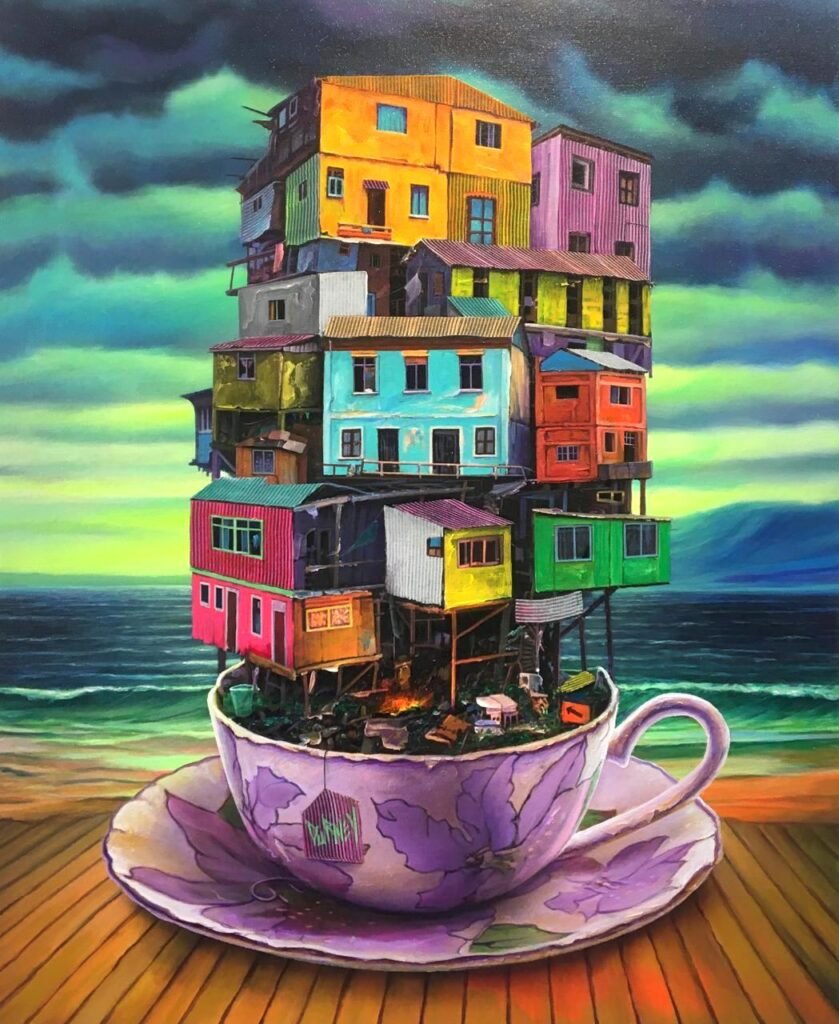
(ES) En la obra de Durney converge la condición lúdica del arte junto una particular mirada a la arquitectura sociocultural de nuestros tiempos. Con un planteamiento que remite a Arcimboldo y a la propia formación de Durney como arquitecto, los distintos materiales, maquinarias y estructuras del puerto son recombinados por el artista, originando nuevas-viejas edificaciones, marcadas por el desgaste y la ruina. La ironía habita la pintura, en una carnada que pareciera el oro de los tontos, en el absurdo epitafio, en ese perro que asoma con mirada chora por entre las latas.
En el último tiempo, Durney ha extrapolado su campo de investigación a la escena mundial, incorporando en sus telas a diversos íconos culturales, arquitectónicos y urbanos, difundidos de manera incesante desde los polos culturales, e insertados en nuestro software de referencias, como parte de nuestra heredada afición a la colonia y su aroma colonizador.
A partir de íconos representativos – La Torre Eiffel, London Buses, el moai de “Te – Tokanga”, etc. – el artista desarrolla una “estrategia de alteración”, que subvierte su significación. En pinturas tales como “Brexit Consequences”, “Okupado” y “La Torre de los Chalecos Amarillos”, entre otras, las fachadas derruidas proliferan en detritus cultural, y bajo su superficie late (o latió) un entramado de mecano anquilosado. Las pinturas funcionan como un tour surrealista al corazón del castillo de Occidente. El viaje está lleno de ironías, pero también constituye un diagnóstico feroz a nuestra época y su agotadora estridencia.
En la obra de Durney destaca también la incorporación de la electrónica, a través de su integración al plano pictórico mediante luces LED, remitiendo con ellas a las pantallas pretéritas o presentes que proliferan en lo cotidiano, como en el caso de las obras “Philco en el Ojo” e “Indiferencia Cultural”.
Entre sus exposiciones y distinciones destacan «Acciones Surrealistas», Exposición individual realizada en la Galería Bahía Utópica para celebrar los 100 años de la publicación del Manifiesto Surrealista (2024-2025); «Valporiza2» (Galería Bahía Utópica, 2023-2024), donde Durney propone «valporizar» el mundo bajo la lógica arquitectónica porteña; Cerdos Pork-Teños, en Museo Palacio Vergara (Viña del Mar, 2023); «Distopía Alegre», muestra en la que Durney extrapoló su investigación visual del entorno local hacia problemáticas de la escena mundial (Galería Bahía Utópica, 2019); “DobleStandar”, en Sala El Farol de la Universidad de Valparaíso (2018); “Transportravestivalpo”, en Galería Bahía Utópica (Valparaíso, 2012), Mención Honrosa “Concurso Mi Ciudad de de la Ilustre Municipalidad de Valparaíso (2010), Seleccionado VII International Water-color Bienal, Viña del Mar (2010) y “Cerdo Led” (2009).
(EN) Durney’s work brings together the playful nature of art with a unique perspective on the sociocultural architecture of our times. With an approach that draws on Arcimboldo and Durney’s own training as an architect, the artist recombines the various materials, machinery, and structures of the port, giving rise to new-old buildings marked by wear and decay. Irony permeates the painting—in a lure that resembles fool’s gold, in the absurd epitaph, in that dog peering out with a sly gaze from among the cans.
Recently, Durney has expanded his field of inquiry to the global stage, incorporating into his canvases various cultural, architectural, and urban icons—constantly disseminated from cultural hubs and embedded in our mental framework of references—as part of our inherited fascination with colonialism and its colonizing aura.
Drawing on iconic images—the Eiffel Tower, London buses, the moai from “Te–Tokanga,” etc.—the artist develops a “strategy of alteration” that subverts their meaning. In paintings such as “Brexit Consequences,” “Okupado,” and “The Tower of the Yellow Vests,” among others, crumbling facades are strewn with cultural detritus, and beneath their surface beats (or once beat) a rusted-out Meccano framework. The paintings function as a surrealist tour into the heart of the Western castle. The journey is full of ironies, but it also constitutes a scathing diagnosis of our era and its exhausting stridency.
Durney’s work also stands out for its incorporation of electronics, integrated into the pictorial plane through LED lights, which evoke the screens—both past and present—that proliferate in everyday life, as in the works “Philco en el Ojo” and “Indiferencia Cultural.”
Among his exhibitions and awards, the following stand out: “Surrealist Actions,” a solo exhibition held at the Bahía Utópica Gallery to celebrate the 100th anniversary of the publication of the Surrealist Manifesto (2024–2025); “Valporiza2” (Bahía Utópica Gallery, 2023–2024), in which Durney proposes to ‘valporize’ the world according to Buenos Aires’ architectural logic; “Cerdos Pork-Teños,” at the Palacio Vergara Museum (Viña del Mar, 2023); “Distopía Alegre,” an exhibition in which Durney extrapolated his visual research of the local environment to address issues on the global stage (Bahía Utópica Gallery, 2019); “DobleStandar,” at the El Farol Gallery at the University of Valparaíso (2018); “Transportravestivalpo,” at Galería Bahía Utópica (Valparaíso, 2012); Honorable Mention in the “Mi Ciudad” Contest organized by the Municipality of Valparaíso (2010); Selected for the 7th International Watercolor Biennial, Viña del Mar (2010); and “Cerdo Led” (2009).